
Complete User Guide for the four-in-one detectors
Publication Date:2026/03/17The four-in-one detectors (typically used to detect oxygen, combustible gases, hydrogen sulfide, and carbon monoxide) is one of the most widely used portable devices in the field of industrial safety. For industrial users, the operating procedure involves more than just the sequence of button presses; it constitutes a rigorous “closed-loop risk management system.” Mainstream safety culture emphasizes “compliance,” “preventive maintenance,” and “data traceability.” Below is a comprehensive user guide for the four-in-one detectors, compiled by the Yiyuntian Eranntex editorial team, that complies with international safety standards. It covers every critical step from pre-operation preparation to post-task data management.

Phase 1: Pre-Operation Inspection and Self-Test
Before entering a potentially hazardous area, ensuring the device is in a “ready state” is the primary principle. This goes beyond simply turning on the device; it involves verifying the device’s operational health.
First, conduct a visual physical inspection. Check the four-in-one detectors housing for cracks, verify that the sensor filter membranes are not clogged or damp, and ensure the air intake is free of dust. Inspect the explosion-proof fasteners to confirm they are intact, ensuring the device’s intrinsic safety performance remains intact.
Press the power button to start the device. The instrument will enter automatic self-test mode. At this point, the display will light up in full screen, and the alarm light, buzzer, and vibration motor will activate sequentially. The operator must carefully verify that all three alarm methods are functioning properly, as in high-noise or dimly lit industrial environments, vibration and flashing lights are often the only signals capable of attracting attention. Subsequently, the screen will display the sensor status. Ensure that none of the target gas channels show an “X” mark or error code, and that the battery charge is sufficient to last the entire work shift.
Stage 2: Fresh Air Calibration and Functional Testing
Powering on the instrument does not guarantee accuracy. Before officially entering the work site, international safety standards typically require a “fresh air calibration” or “shock test.”
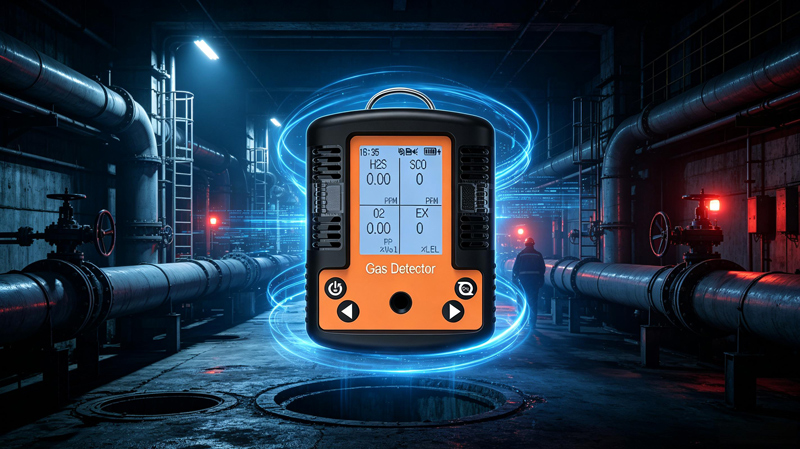
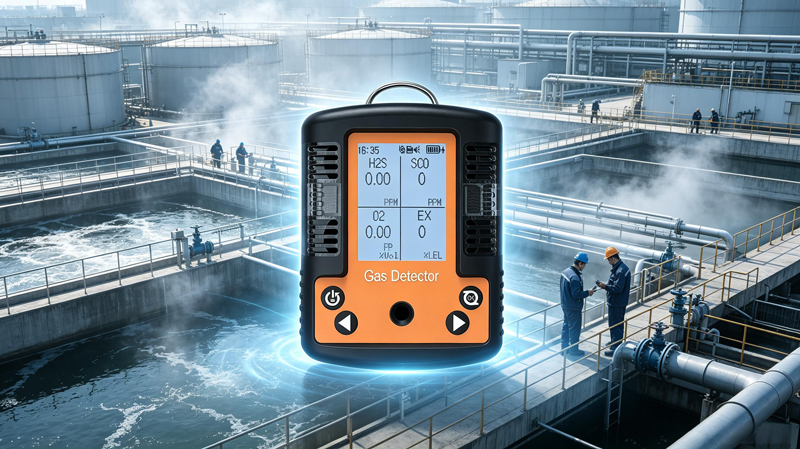
If the instrument is turned on in a clean office environment or an open outdoor area, it should display standard readings: oxygen content at 20.9% VOL, and combustible gas (LEL), carbon monoxide (CO), and hydrogen sulfide (H₂S) at 0. If slight deviations in readings are detected, perform a “fresh air calibration” to reset the instrument.
For high-risk operations, simply resetting the instrument is insufficient. It is recommended to perform a “surge test” using a standard gas cylinder with a known concentration. Connect the standard gas cylinder to the instrument’s intake port via a calibration hood, and observe whether the reading rapidly rises to the standard gas concentration after gas is introduced. If the reading falls within the allowable error range and triggers an alarm, this confirms that the sensor is sensitive and effective.
Stage 3: Dynamic Monitoring During On-Site Operations
Once on-site, the detector should always be worn in the operator’s breathing zone (typically within 30 centimeters of the mouth and nose) and must not be obscured by clothing.
During monitoring, operators must understand the logic behind alarm thresholds. Modern four-in-one detectors typically feature multi-level alarms (such as low-level STEL and high-level TWA alarms). If the four-in-one detectors triggers a low-level alarm, this does not necessarily mean immediate evacuation is required, but it indicates an abnormal condition in the environment; the source must be investigated and ventilation improved. If a high-level alarm is triggered or readings rise sharply, evacuation procedures must be initiated immediately.
Additionally, pay attention to the detector’s “response time.” Sensors require time to react to gases, so operators should maintain a slow, steady pace and avoid running while monitoring. Especially when locating leak points, the probe should be aimed at potential leak sources such as flanges and valves and held there for several seconds to obtain accurate readings. At the same time, be vigilant against the risk of “sensor poisoning.” If the detector’s reading suddenly drops to zero or remains at full scale, it may indicate that the sensor has failed due to exposure to high-concentration toxic gases; in this case, evacuation must be initiated immediately.
Phase 4: Specific Procedures for Entering Confined Spaces
Confined space operations represent the most critical application scenario for four-in-one detectors, and the principle of “test first, enter later” must be strictly followed.
Before personnel enter, layered testing must be conducted. Due to differences in gas density, hydrogen sulfide is heavier than air and settles at the bottom; methane is lighter than air and accumulates at the top; oxygen and carbon monoxide have densities similar to air and remain suspended in the middle. Operators must use an extended sampling tube to insert the probe into the top, middle, and bottom of the confined space for sampling, respectively.
An entry permit may only be issued when the oxygen concentration is between 19.5% and 23.5% and the concentrations of toxic and hazardous gases are below safe limits. During operations, the detector should not be turned off; it is best to suspend it near the work area or have a monitor hold it to monitor environmental changes in real time and prevent the release of new toxic gases caused by stirring up sludge or cutting operations.
Stage 5: Post-Task Maintenance and Data Management
The process does not end once the operation is complete. Remove the instrument from the hazardous area and clean the housing with a soft, damp cloth, paying particular attention to the sensor air inlets to prevent dust or liquid residue from affecting future measurements.
Data management is a critical component of modern safety management. Connect the detectors to a computer via USB or Bluetooth to download the day’s gas exposure logs. These data serve not only as evidence for safety compliance audits but also help companies analyze potential risk sources. For example, if the log shows frequent fluctuations in CO concentration in a certain area, the company may need to investigate combustion efficiency issues with equipment in that area.
Finally, return the four-in-one detectors to its charging dock. Ensure the battery is fully charged so it is ready for the next emergency response. Following the standardized maintenance process of “Use-Clean-Download Data-Charge” maximizes the device’s lifespan and ensures reliability for every deployment.
Related information
-
How to Calibrate a Portable four-in-one Gas Detectors?
Portable four-in-one gas detectors are core protective equipment in the industrial safety field. However, sensors can experience z...
2026-09-18 -
What are the application scenarios for portable four-in-one gas detectors?
Portable four-in-one gas detectors typically monitor oxygen (O₂), flammable gas (LEL), carbon monoxide (CO), and hydrogen sulfide...
2026-09-16 -
Portable four-in-one Gas Detectors User Manual
The portable four-in-one gas detectors is a core piece of personal protective equipment (PPE) for ensuring the safety of personnel...
2026-09-14 -

Calibration Specifications for Ammonia gas Detectors
Calibration of ammonia gas detectors is a core step in ensuring their measurement accuracy and alarm reliability. However, ammonia...
2026-09-11 -
What is the appropriate installation height for an ammonia gas detectors?
Ammonia (NH₃) has a relative density of only 0.59, much lighter than air. This means that in the event of a leak, the gas will qu...
2026-09-09


 info@eranntexgas.com sale1@eranntexgas.com


 15914124845