
What are some common errors in carbon monoxide detectors calibration?
Publication Date:2026/06/26For metrology and calibration personnel, safety supervisors, and equipment maintenance engineers, the calibration of carbon monoxide detectors is a crucial step in ensuring their accuracy and reliability. In practice, due to a lack of thorough understanding of the characteristics of electrochemical sensors or standard operating procedures (SOPs), the calibration process is often prone to pitfalls. Below are some common errors in the calibration process summarized by Yiyuntian Eranntex and their avoidance strategies.
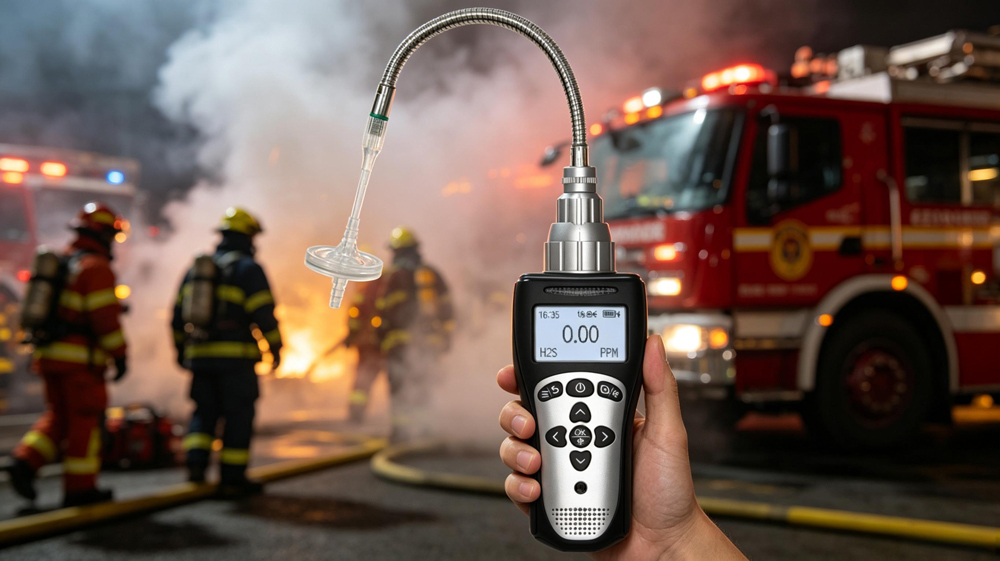
Insufficient warm-up time leading to zero drift
This is the most common and insidious error in on-site calibration. Many operators, after turning on the carbon monoxide detectors and seeing the screen light up or display zero, rush to perform zero-point calibration. However, the electrochemical sensor needs a certain amount of time to reach electrochemical equilibrium. Immediately after power-on, the electrode surface may retain gas from the previous test, or the internal electrolyte temperature may not have stabilized, causing a slow zero-point drift. The correct approach is to ensure at least 10 to 30 minutes of sufficient warm-up after power-on. Zero-point calibration can only be performed when the zero-point reading remains stable for several minutes; otherwise, the calibration results for the day will be meaningless.
Improper Sampling Tubing Material Leads to Gas Adsorption
The choice of tubing material is crucial when calibrating with standard gas. While carbon monoxide is relatively stable, when handling other toxic gases, using ordinary rubber or PVC tubing can easily lead to adsorption of reactive gases by the tubing walls. For example, if 50 ppm of standard gas is introduced, after passing through a one-meter-long rubber tube, the actual concentration reaching the sensor may be only 40 ppm. This can cause calibrators to mistakenly believe the sensor sensitivity is low and incorrectly increase the gain, resulting in frequent false alarms after the carbon monoxide detectors is returned to the field. Therefore, calibration must use sampling tubes made of PTFE or stainless steel, and before first use, the tube should be purged with standard gas for several minutes to saturate the inner wall with adsorption.
Ignoring Environmental Cross-Interference and Cleanliness
Electrochemical sensors are not absolutely single-response; they often exhibit cross-sensitivities. For example, carbon monoxide sensors also respond to hydrogen, and hydrogen sulfide sensors are sensitive to sulfur dioxide. If calibration is performed in an underground parking lot filled with car exhaust, a room recently sprayed with pesticides, or an environment with volatile solvents, the sensor will respond to both the target gas and interfering gases in the environment, leading to severe distortion of calibration data. Calibration must be performed in a clean environment, or, if clean air is unavailable, using a zero-air generator to ensure the absolute purity of the calibration reference.
Lack of Temperature and Humidity Compensation Mechanisms
Environmental conditions have a significant impact on the performance of carbon monoxide sensors. When the ambient temperature exceeds 30°C or even reaches 40°C, the sensor's zero point will change drastically; without temperature compensation, the alarm value originally set at 30 ppm may deviate by as much as 20 ppm. Furthermore, the electrochemical reaction of carbon monoxide requires the participation of water molecules; extreme humidity conditions not only alter the sensor's reactivity but may also affect its lifespan. When performing high-precision calibration, the effects of temperature and humidity on the zero point and sensitivity must be fully considered, and it must be confirmed that the carbon monoxide detectors has a corresponding three-dimensional compensation algorithm.
Improper Calibration Point Configuration and Operation
When calibrating to full scale or span, a precisely matched standard gas is sometimes unavailable on-site. Some personnel may use incorrect methods to arbitrarily prepare the gas or use expired standard gas. The correct approach is to use a high-precision flow meter with a three-way valve to mix the high-concentration standard gas with zero gas in a precise ratio when a standard gas of a specific concentration is unavailable, thus preparing the required intermediate concentration point. Simultaneously, the standard gas used for calibration must be within its validity period and have a traceable metrological verification certificate. Furthermore, for pump-type alarms, a three-way diversion method must be used to ensure that the sensor draws in gas under normal pressure, avoiding inaccurate data due to back pressure.
By strictly avoiding the above operational errors and establishing standardized calibration procedures, companies can ensure that carbon monoxide detectors provide accurate and reliable safety warnings at critical moments.
Related information
-
How to Calibrate a Portable four-in-one Gas Detectors?
Portable four-in-one gas detectors are core protective equipment in the industrial safety field. However, sensors can experience z...
2026-09-18 -
What are the application scenarios for portable four-in-one gas detectors?
Portable four-in-one gas detectors typically monitor oxygen (O₂), flammable gas (LEL), carbon monoxide (CO), and hydrogen sulfide...
2026-09-16 -
Portable four-in-one Gas Detectors User Manual
The portable four-in-one gas detectors is a core piece of personal protective equipment (PPE) for ensuring the safety of personnel...
2026-09-14 -

Calibration Specifications for Ammonia gas Detectors
Calibration of ammonia gas detectors is a core step in ensuring their measurement accuracy and alarm reliability. However, ammonia...
2026-09-11 -
What is the appropriate installation height for an ammonia gas detectors?
Ammonia (NH₃) has a relative density of only 0.59, much lighter than air. This means that in the event of a leak, the gas will qu...
2026-09-09
 info@eranntexgas.com sale1@eranntexgas.com


 15914124845