
Operational Procedures for Daily Inspection of Oxygen Detectors
Publication Date:2026/08/31In high-risk environments—such as industrial manufacturing, petrochemical processing, and confined space operations—oxygen detectors serve as a critical line of defense for worker safety. However, even the most sophisticated instruments can fail at crucial moments if they lack standardized daily inspections. For multinational enterprises, establishing a clear, rigorous daily inspection protocol that aligns with international safety practices is the cornerstone of ensuring equipment reliability. Let’s take a look at the procedure with the team from Yiyuntian Eranntex.
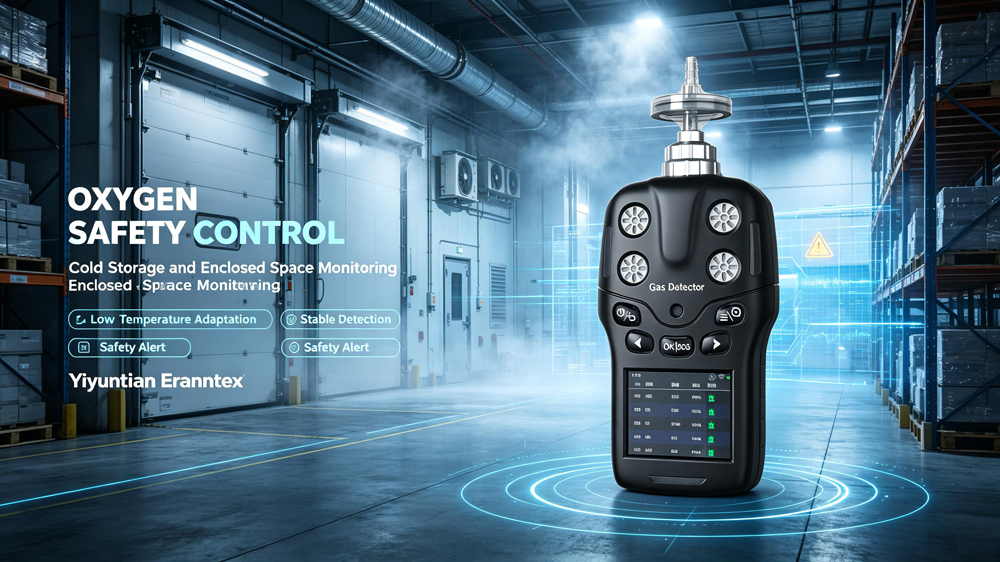
The operational procedure for the daily inspection of oxygen detectors is as follows:
I. Pre-shift Visual and Basic Status Check
The first step of the daily inspection involves a visual assessment of the device's physical condition. Before starting a shift, operators must carefully inspect the detector's casing for integrity, checking for cracks or severe wear. They must ensure the sensor inlet is unobstructed—free from dust, moisture, or oil—and verify that the buttons are responsive and the display screen is functioning correctly (without missing segments or blackouts). Additionally, operators must confirm sufficient battery levels; it is recommended to charge or replace the battery if the charge drops below 80% to prevent monitoring interruptions caused by power loss during operations. If the device fails any aspect of the visual or basic status check, it must be immediately tagged as "Faulty" and taken out of service.
II. Power-on Self-test and Zero-point Calibration in Clean Air
Standardized operation requires starting in a safe environment. Operators should power on the device in an outdoor area known to have clean, well-ventilated air. Upon startup, the oxygen detectors automatically runs a self-test to verify the functionality of the sensor, circuitry, and audible/visual alarm systems. Once the self-test passes and the reading stabilizes, the operator must confirm that the displayed oxygen concentration is approximately 20.9% VOL. If there is a significant deviation in the reading, a "zero-point calibration" or "fresh air calibration" must be performed immediately to set the current clean air environment as the baseline for detection. This step effectively eliminates baseline drift caused by environmental changes and is a crucial link in ensuring data accuracy.
III. Bump Test: The Key to Verifying Alarm Functionality
This is the most critical yet frequently overlooked step in daily inspections. It is strongly recommended to perform a bump test on the oxygen detectors before every use. Operators must briefly expose the sensor to a standard oxygen gas of known concentration to observe whether the instrument responds rapidly within the specified timeframe and accurately triggers the preset audible, visual, and vibrating alarms for low or high oxygen levels. The purpose of a bump test is not calibration, but rather a quick verification that the sensor retains the ability to detect hazards and trigger alarms. If the bump test fails, the device must be taken out of service immediately and scheduled for professional maintenance.
IV. Inspection Records and Closed-Loop Anomaly Handling
All daily inspection activities must be documented. Operators are required to accurately record the inspection date, device ID, battery status, zero-point reading, and bump test results in the "Daily Equipment Inspection Log." This serves not only as vital evidence for meeting international safety compliance audits but also provides a basis for data traceability in future equipment maintenance. If any anomalies are detected during the inspection, the anomaly handling procedure must be strictly followed: immediately stop using the oxygen detectors, isolate it, and report the issue to the safety supervisor. It is strictly prohibited to take a faulty device into a hazardous work area based on a false sense of security or wishful thinking.
V. Conclusion
Daily inspection of oxygen detectors is by no means a mere formality; it is a solemn commitment to protecting lives. Through pre-shift visual checks, power-on zero calibration, bump test verification, and standardized record management, enterprises can establish a closed-loop system for preventive maintenance throughout the equipment's lifecycle. Only when this rigorous inspection process becomes second nature—ingrained in the muscle memory of every frontline operator—can the oxygen detectors truly serve as a reliable safeguard for life and safety.
Related information
-
How to Calibrate a Portable four-in-one Gas Detectors?
Portable four-in-one gas detectors are core protective equipment in the industrial safety field. However, sensors can experience z...
2026-09-18 -
What are the application scenarios for portable four-in-one gas detectors?
Portable four-in-one gas detectors typically monitor oxygen (O₂), flammable gas (LEL), carbon monoxide (CO), and hydrogen sulfide...
2026-09-16 -

Portable four-in-one Gas Detectors User Manual
The portable four-in-one gas detectors is a core piece of personal protective equipment (PPE) for ensuring the safety of personnel...
2026-09-14 -

Calibration Specifications for Ammonia gas Detectors
Calibration of ammonia gas detectors is a core step in ensuring their measurement accuracy and alarm reliability. However, ammonia...
2026-09-11 -
What is the appropriate installation height for an ammonia gas detectors?
Ammonia (NH₃) has a relative density of only 0.59, much lighter than air. This means that in the event of a leak, the gas will qu...
2026-09-09




 info@eranntexgas.com sale1@eranntexgas.com


 15914124845