
What is the appropriate installation height for an ammonia gas detectors?
Publication Date:2026/09/09Ammonia (NH₃) has a relative density of only 0.59, much lighter than air. This means that in the event of a leak, the gas will quickly rise and accumulate at the top of the space. This physical characteristic fundamentally dictates the installation height of ammonia detectors—they must be installed high up. However, "high up" does not simply mean attaching it to the ceiling. For EHS managers, safety engineers, and facility maintenance teams, scientifically determining the installation height of ammonia gas detectors is the first step in ensuring the effectiveness of detection. Below, Yiyuntian Eranntex will introduce the appropriate installation height.
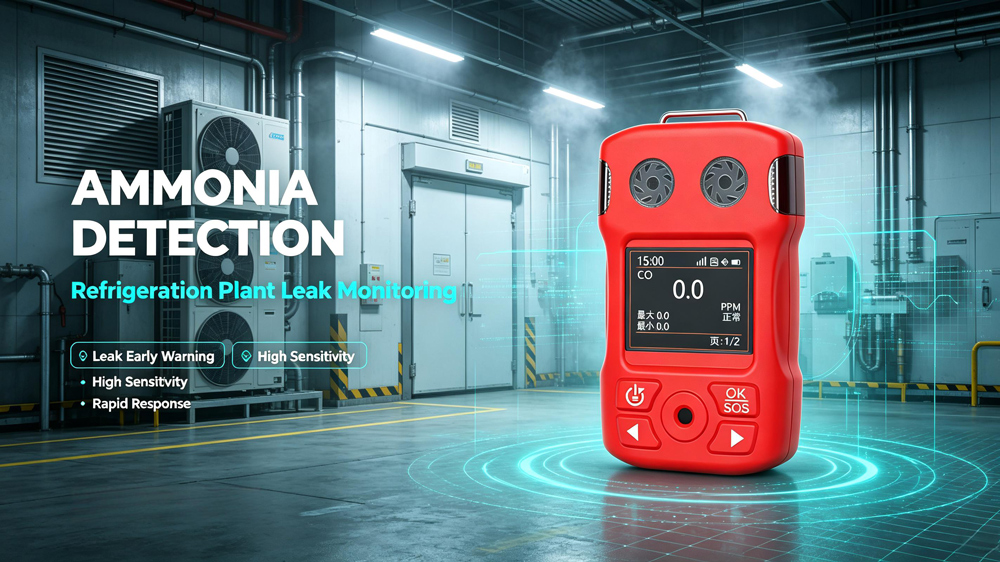
Core Principle: 0.5 to 2 meters above the release source
According to GB/T 50493-2019 "Design Standard for Detection and Alarm of Combustible and Toxic Gases in Petrochemical Industry" and GB 12358-2024 "General Technical Requirements for Ambient Gas Detection and Alarm Instruments in Workplaces," ammonia belongs to the category of gases "lighter than air (ratio ≤ 0.8)." Therefore, the installation height of its fixed detectors should be set within the range of 0.5 to 2.0 meters above the release source. The logic behind this range is that ammonia leaks do not instantly reach the ceiling, but rather form a gas cloud of a certain concentration during its ascent. Placing the detector within this "ascent channel" allows for the fastest possible detection of the leak signal. Furthermore, in enclosed plant buildings, in addition to the area above the release source, a detector should also be installed at the highest point of the building to capture any residual gas that eventually accumulates at the top.
30 to 60 centimeters from the ceiling: Avoiding dead air zones
In conventional industrial plants, the standard installation height for ammonia gas detectors is 30 to 60 centimeters from the ceiling. This height selection is based on two key considerations: First, directly mounting the sensor to the ceiling creates a dead zone for airflow, making it difficult for leaked gas to be effectively drawn into the sensor after forming a thin layer on the ceiling surface; second, maintaining a distance of 30 to 60 centimeters allows for natural air convection, ensuring that leaked gas diffuses smoothly to the sensor surface. It is important to note that the sensor's detection surface should be installed facing downwards to prevent dust and water from directly entering and to ensure detection accuracy.
1.5 to 2 meters from the ground: A compromise between detection and maintenance
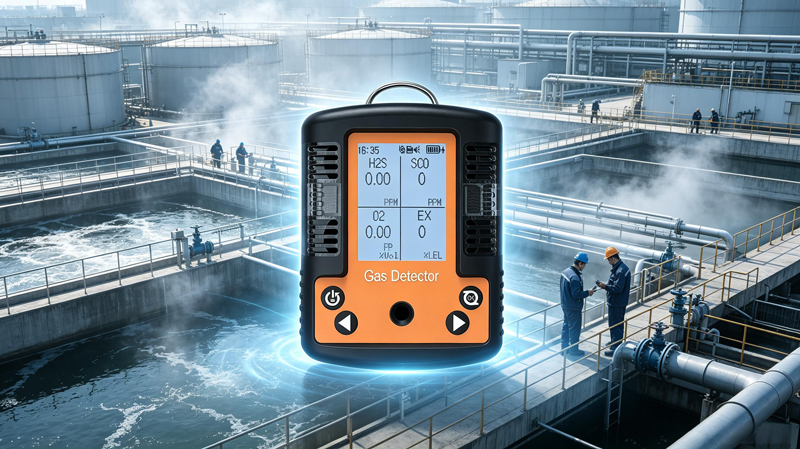
In open spaces such as cold storage facilities and wastewater treatment plants, installation at a distance of 30 to 60 centimeters from the ceiling may present maintenance inconvenience. In such cases, industry practice commonly adopts an installation height of 1.5 to 2 meters from the ground. This installation height for ammonia gas detectors effectively captures rising ammonia gas clouds while facilitating routine inspections, calibrations, and maintenance operations by maintenance personnel. Taking cold storage scenarios as an example, detectors in liquid ammonia refrigeration rooms are typically installed at a height of 1.5 to 2 meters above the ground, close to potential leak points such as pipes, valves, and compressors, ensuring alarms are triggered at the initial stage of a leak.
Height Adaptation Strategies for Different Scenarios
Different application scenarios have significantly different requirements for the installation height of ammonia gas detectors, requiring flexible adjustments based on site conditions:
Enclosed plants and workshops: Strictly adhere to the principle of "0.5 to 2 meters above the release source," with detectors installed within 1 meter of potential leak points such as pipes, valves, flanges, and compressors.
Underground pipe corridors and well spaces: Detectors should be installed approximately 0.3 meters below the top, balancing the capture of rising ammonia with ease of operation for inspection personnel.
Open pools (such as equalization tanks and anaerobic tanks in wastewater treatment plants): Probes should be approximately 1.5 meters above the pool surface, ensuring unobstructed access and proper ventilation.
Plant boundary monitoring: Deploy detectors within a 1.5 to 2-meter range, depending on the height of the discharge outlet, to ensure the capture of spilled gas.
Auxiliary Requirements for Installation Location
Besides height, the choice of installation location for ammonia gas detectors is equally crucial. Detectors should ideally be located close to the leak source (within 0.5 to 2 meters of the release source), but must avoid areas with strong airflow, such as air conditioning vents and powerful exhaust fans, to prevent rapid dilution of the leaked gas and resulting detection delays. Simultaneously, they should be kept away from heat sources, strong electromagnetic fields, and areas with high moisture content. A clearance of at least 0.3 meters should be maintained between the equipment and surrounding pipes and obstacles to allow space for future maintenance and calibration. In large areas, it is recommended to install one detector every 10 to 15 meters; in corridors and pipe racks, the spacing should be shortened to 8 to 10 meters to ensure full monitoring coverage without blind spots.
In summary, the installation height of ammonia gas detectors is not a fixed, one-size-fits-all value, but rather requires a comprehensive judgment based on gas density characteristics, spatial structure, leak source location, and ease of maintenance. The core logic remains: ammonia is lighter than air, so the detector must be installed higher, but the specific height depends on the actual on-site conditions. Only by combining scientifically set heights with reasonable site layouts can a truly effective ammonia safety protection network be built.
Related information
-
How to Calibrate a Portable four-in-one Gas Detectors?
Portable four-in-one gas detectors are core protective equipment in the industrial safety field. However, sensors can experience z...
2026-09-18 -
What are the application scenarios for portable four-in-one gas detectors?
Portable four-in-one gas detectors typically monitor oxygen (O₂), flammable gas (LEL), carbon monoxide (CO), and hydrogen sulfide...
2026-09-16 -
Portable four-in-one Gas Detectors User Manual
The portable four-in-one gas detectors is a core piece of personal protective equipment (PPE) for ensuring the safety of personnel...
2026-09-14 -

Calibration Specifications for Ammonia gas Detectors
Calibration of ammonia gas detectors is a core step in ensuring their measurement accuracy and alarm reliability. However, ammonia...
2026-09-11 -
What is the appropriate installation height for an ammonia gas detectors?
Ammonia (NH₃) has a relative density of only 0.59, much lighter than air. This means that in the event of a leak, the gas will qu...
2026-09-09
 info@eranntexgas.com sale1@eranntexgas.com


 15914124845