
How Long Does a Carbon Dioxide Detectors Last?
Publication Date:2026/09/02The lifespan of a carbon dioxide detectors is a core issue that every safety manager and procurement decision-maker must address. However, the lifespan varies greatly between portable devices costing a few hundred yuan and industrial-grade stationary systems costing tens of thousands of yuan—some only last one year, while others can operate stably for over 10 years. For procurement personnel, understanding the technical logic behind the lifespan is far more important than focusing on a general number. Below, Yiyuntian Eranntex will guide you through a deeper exploration.
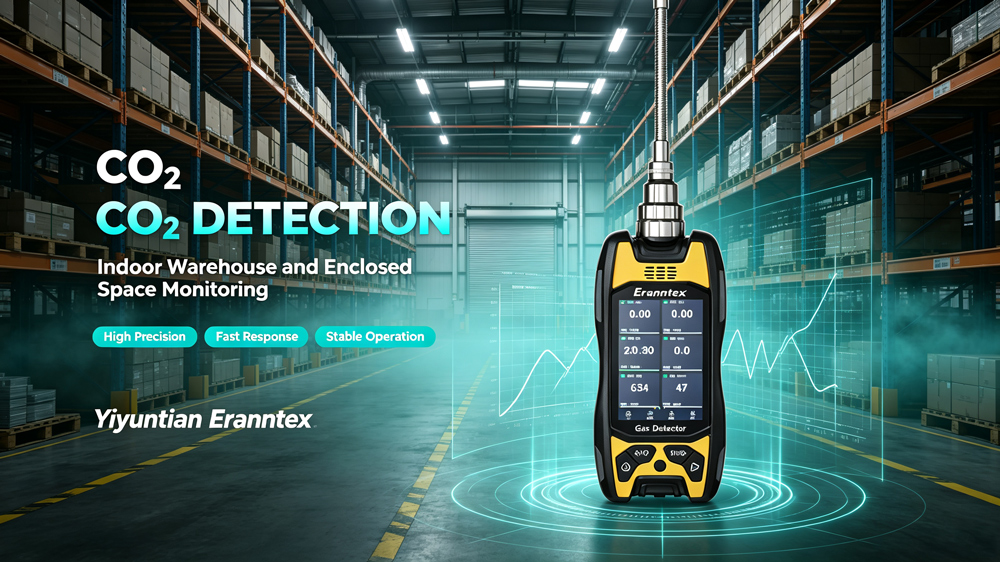
I. Sensor Principles Determine the Upper Limit of Lifespan
The lifespan of a carbon dioxide detectors essentially depends on the technical principle of its core sensor. Currently, the mainstream CO₂ detection technologies on the market mainly include the following, with significant differences in lifespan:
Non-dispersive infrared (NDIR) sensor: This is the gold standard for industrial-grade CO₂ detection. Its principle is to irradiate the gas with an infrared light source and utilize the absorption characteristics of CO₂ to specific wavelengths of infrared light to determine the concentration. Since there is no chemical consumption process, the lifespan of an NDIR sensor mainly depends on the natural decay of the internal infrared light source. Under normal operating conditions, NDIR sensors have a lifespan of 5 to 10 years, making them the longest-lasting CO₂ detection technology currently available.
Thermal Conductivity (TC) Sensors: These detect CO₂ based on the difference in thermal conductivity between CO₂ and air. The core component is a miniature heated silicon chip. They have no light source and a theoretically extremely long lifespan, typically exceeding 10 years. Their main failure risk comes from the corrosion of the component surface by high concentrations of corrosive gases.
Solid-State Electrochemical Sensors: These are consumable sensors. The internal electrolyte and electrodes are gradually consumed in chemical reactions. Their lifespan is typically 1 to 3 years, suitable for short-term, rapid-response alarm detection scenarios, but long-term holding costs are high.
Photoacoustic Spectroscopy (PAS) Sensors: As an emerging technology, their lifespan is comparable to NDIR, reaching 5 to 10 years. However, the internal miniature microphone requires mechanical fatigue protection under strong mechanical vibration or high-decibel noise environments.
II. The Operating Environment as an "Accelerator" or "Decelerator" of Lifespan
Even sensors using the same principle can have actual lifespans differing by several times under different environments. The following three types of harsh environments significantly accelerate sensor aging:
High Temperature and High Humidity Environments: When the temperature exceeds 60℃ and the relative humidity is above 90%, the electrolyte in electrochemical sensors evaporates more rapidly, and condensation may occur in the optical chamber of infrared sensors, leading to infrared light scattering or data anomalies. In high-temperature workshops of metallurgical plants or coastal areas with high humidity, sensor lifespan may be shortened by 30% to 50%.
Continuous Impact of High-Concentration Gases:If sensors are exposed to high concentrations of CO₂ for extended periods, it will accelerate the wear and tear of core components. For example, sensors frequently exposed to high concentrations of CO₂ in fermentation workshops or cold storage facilities may have their lifespan shortened from 5 years to 2 to 3 years.
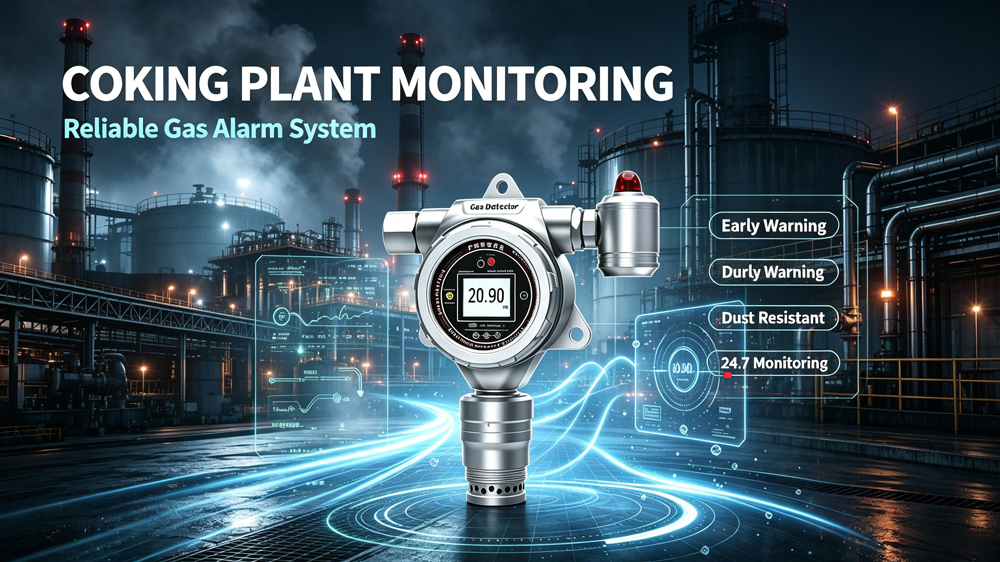
Dust and Corrosive Gases: In environments such as coking plants and livestock farms, dust can clog the sensor's air intake filter and optical chamber, while corrosive gases can erode sensor elements, leading to a sharp decline in performance.
III. Calibration and Maintenance: Key Strategies for Extending Lifespan
A scientific maintenance system is the core means to extend the lifespan of carbon dioxide detectors and ensure data accuracy. Internationally accepted best practices include:
Regular Calibration:Under normal operating conditions, a comprehensive calibration using standard gas is recommended annually. In harsh environments such as high dust, strong corrosion, or high humidity, the calibration cycle should be shortened to every six months. Calibration not only corrects baseline drift but also promptly detects trends in sensor performance degradation.
Bump Test:It is recommended to introduce a standard gas of known concentration before each use to quickly verify the sensor's response speed and alarm function. This is the lowest-cost and most direct routine maintenance method.
Daily Cleaning and Protection: Regularly clean the dust filter and air inlet to prevent dust blockage; in high-humidity environments, choose equipment with a breathable and waterproof membrane; avoid prolonged contact of the sensor with impurity gases to prevent "poisoning" and aging.
IV. How to Determine if a Sensor Has Reached the End of Its Service Life:
When the following conditions occur, it indicates that the sensor is nearing or has reached the end of its service life and should be replaced promptly:
The expected response value cannot be achieved after calibration, and the error continues to exceed the allowable range.
Severe baseline drift and persistently unstable zero-point readings.
The response time has significantly increased, and sensitivity has decreased dramatically.
The carbon dioxide detectors is frequently reporting false alarms or missed alarms.
For businesses, it is recommended to establish a sensor lifespan log, recording the installation date, calibration records, and performance change trends for each device. A replacement plan should be initiated when the sensor reaches 80% of its nominal lifespan to avoid safety blind spots caused by equipment failure.
In conclusion, the lifespan of a carbon dioxide detectors is not a fixed number, but rather the result of the combined effects of sensor principles, the operating environment, and maintenance levels. By selecting sensor technology suitable for the operating conditions, optimizing the deployment environment, and establishing a scientific maintenance system, businesses can maximize the effective lifespan of their equipment, ensuring safety while reducing total lifespan ownership costs.
Related information
-
How to Calibrate a Portable four-in-one Gas Detectors?
Portable four-in-one gas detectors are core protective equipment in the industrial safety field. However, sensors can experience z...
2026-09-18 -
What are the application scenarios for portable four-in-one gas detectors?
Portable four-in-one gas detectors typically monitor oxygen (O₂), flammable gas (LEL), carbon monoxide (CO), and hydrogen sulfide...
2026-09-16 -
Portable four-in-one Gas Detectors User Manual
The portable four-in-one gas detectors is a core piece of personal protective equipment (PPE) for ensuring the safety of personnel...
2026-09-14 -

Calibration Specifications for Ammonia gas Detectors
Calibration of ammonia gas detectors is a core step in ensuring their measurement accuracy and alarm reliability. However, ammonia...
2026-09-11 -
What is the appropriate installation height for an ammonia gas detectors?
Ammonia (NH₃) has a relative density of only 0.59, much lighter than air. This means that in the event of a leak, the gas will qu...
2026-09-09
 info@eranntexgas.com sale1@eranntexgas.com


 15914124845