
What is the upper and lower limit of the alarm value of the combustible gas alarm?
Publication Date:2022/09/13 In combustible gas alarm, "LEL" refers to the lower explosion limit, which is a technical term for combustible gas. The low concentration of combustible gas in the air when exposed to open flame is called the lower explosive limit-abbreviated as "LEL & quot;. When the concentration of combustible gas in the air reaches its explosion lower limit, we call the explosion risk of combustible gas environment in this place 100%LEL. Therefore, when we install the combustible gas alarm, in order to ensure safety, the upper and lower limits of its alarm value are required. Do you know the upper and lower limits of the alarm value of combustible gas alarm ? The following is an introduction by Yiyun Tian Xiaobian:
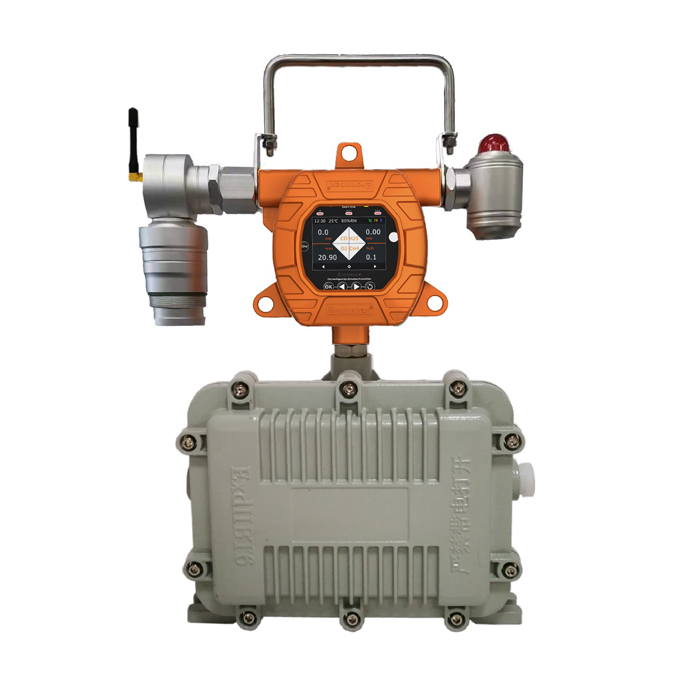
under normal circumstances, the alarm value of combustible gas alarm is set as follows:
The default low limit is 25% LEL(5% LEL ~ 40% LEL adjustable)
The default high limit is: 50% LEL(10% LEL ~ 100 LEL adjustable)
is set as follows:
combustible gas alarm has a measuring range of 0-100% LEL, and is generally set between 15% and LEL-25 LEL according to national regulations.When its gas alarm has two alarm setting values of low limit and high limit, its low limit alarm setting value shall be in the range of 1% lel ~ 25% lel, and its high limit alarm setting value shall be 50% lel. Detectors with only one alarm setting shall have an alarm setting within the range of 1% lel to 25% lel.
Therefore, the alarm value of the combustible gas alarm specified in the national specification is the upper limit, as long as it is not greater than this upper limit, it is within a reasonable range. Of course, in the actual installation process, we should start from the professional practical point of view, the alarm value should not be too low, too low prone to false positives, because too low may conflict with the detection error.
To sum up, it is the upper and lower limits of the alarm value of the combustible gas alarm. If the concentration of combustible gas is too low or too high, it is not dangerous. It will burn or explode only when it is mixed with air to form a mixture or, more precisely, when it meets oxygen to form a certain proportion of the mixture.Due to the higher proportion of air, when monitoring the leakage concentration of combustible gas, it is necessary to monitor the volume concentration value from very low concentration to the lowest explosion limit, that is, the measurement range is 0~100 LEL.
Related information
-
How to Calibrate a Portable four-in-one Gas Detectors?
Portable four-in-one gas detectors are core protective equipment in the industrial safety field. However, sensors can experience z...
2026-09-18 -
What are the application scenarios for portable four-in-one gas detectors?
Portable four-in-one gas detectors typically monitor oxygen (O₂), flammable gas (LEL), carbon monoxide (CO), and hydrogen sulfide...
2026-09-16 -
Portable four-in-one Gas Detectors User Manual
The portable four-in-one gas detectors is a core piece of personal protective equipment (PPE) for ensuring the safety of personnel...
2026-09-14 -

Calibration Specifications for Ammonia gas Detectors
Calibration of ammonia gas detectors is a core step in ensuring their measurement accuracy and alarm reliability. However, ammonia...
2026-09-11 -
What is the appropriate installation height for an ammonia gas detectors?
Ammonia (NH₃) has a relative density of only 0.59, much lighter than air. This means that in the event of a leak, the gas will qu...
2026-09-09
 info@eranntexgas.com sale1@eranntexgas.com


 15914124845